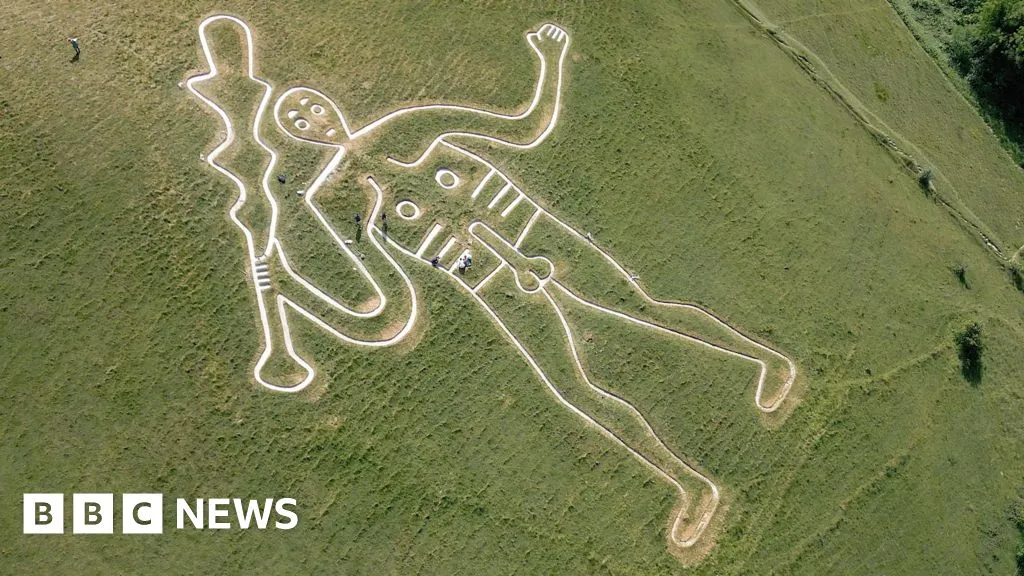
The Cerne Abbas Giant, a centuries-old chalk figure etched into the hillside of Dorset's rural landscape, is set to receive a much-needed restoration as changing weather patterns begin to obscure its once-vibrant outline. National Trust staff, alongside volunteers, will apply 17 tonnes of fresh chalk to the iconic figure this week, restoring the contrast of its formation against the verdant hillside.
At 55 meters tall, the Giant, which depicts a naked man wielding a club, has captivated both locals and tourists for generations. However, with recent observations indicating that wetter winter rains are accelerating the erosion of chalk, its distinct shape is increasingly at risk. Luke Dawson, a ranger with the National Trust, has noted a troubling trend: “Heavier rains are washing away chalk more rapidly, while damp conditions promote algae growth, dulling the Giant's visibility.”
Although the organization refrains from directly linking these changes to climate change, Dawson emphasizes the apparent impact of shifting weather patterns. “It is observation rather than proof,” he clarifies, revealing the complexities in establishing a direct correlation.
Since taking stewardship of the site in 1920, the National Trust has engaged in regular maintenance to ensure the Giant’s visibility, traditionally rechalking the figure every decade. However, this latest restoration, occurring just seven years after the last, illustrates a pressing need for more frequent interventions. With global temperatures having risen approximately 1.4°C since the late 19th century, the Met Office warns that the UK can expect continued trends of wetter winters and hotter summers.
“The weather has made it clear that we may need to reassess our maintenance schedule,” states a spokesperson for the National Trust. The rechalking, expected to take two weeks, will involve approximately 300 dedicated individuals, who must carry the fresh chalk up steep gradients, where in some places the incline is nearly one in three. “It’s a labor-intensive process,” Dawson notes, adding that the technique for applying chalk has remained largely unchanged through the years.
The community engagement surrounding the project is characterized by both excitement and nostalgia, as demonstrated by volunteers participating in this monumental task. Chloe Baugh, who, along with her boyfriend Joe Ford, won the chance to help rechalk the Giant, remarked on the physical demands of the day: “We didn’t know it would be one of the hottest days of the year. It makes you appreciate the generations of people who have done this before us.”
This restoration follows a successful fundraising effort that enabled the National Trust to acquire 138 hectares of land surrounding the Giant, protected as chalk grassland and a habitat for endangered wildlife, including the rare Duke of Burgundy butterfly. The acquisition not only safeguards the Giant, but also the surrounding ecological landscape, promoting accessibility and fostering a deeper understanding of the area's rich history.
Despite the ongoing debates regarding the origin of the Cerne Abbas Giant, which historians have suggested could range from an ancient fertility symbol to a figure inspired by Roman legends, recent scientific studies indicate that its creation likely dates back to the late Saxon period (circa 700 to 1100 AD).
The National Trust’s ongoing commitment to preserving the Cerne Abbas Giant illustrates not only their dedication to heritage conservation but also the increasingly significant influence of climate dynamics on our historical landscapes.
Source: BBC Science