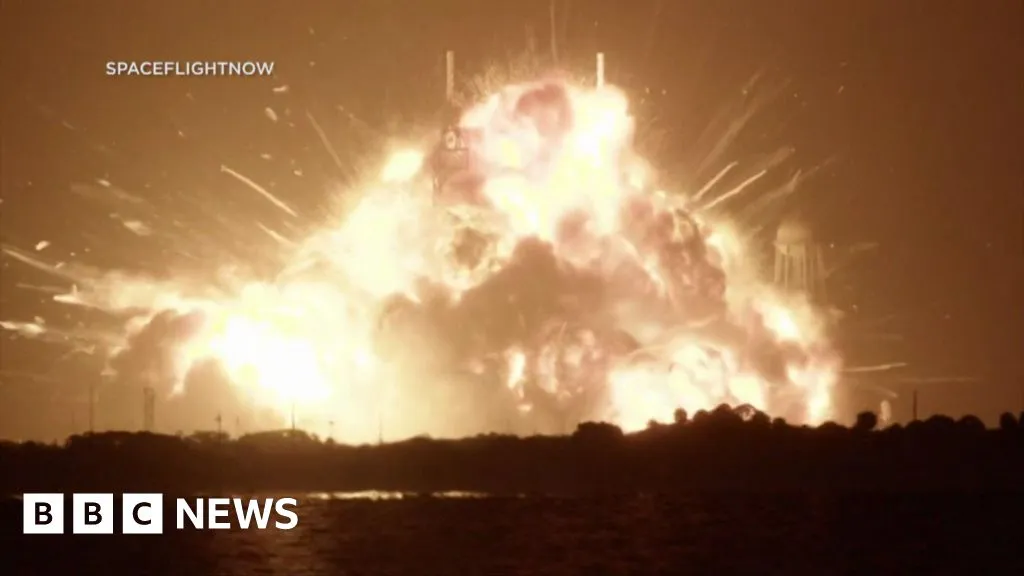
A spectacular explosion of Blue Origin’s New Glenn rocket at Florida’s Kennedy Space Center has thrown NASA’s lunar ambitions into uncertainty. The incident occurred during a routine engine test at approximately 9 PM local time, raising significant concerns about Blue Origin’s ability to fulfill critical commitments crucial to the agency's plans to establish a presence on the Moon.
Initially set to launch 48 satellites as part of Amazon's LEO broadband network by June 4, the explosion not only disrupts the deployment of these satellites but also poses a substantial delay for NASA's Moon missions. Fortunately, the incident resulted in no injuries, with Jeff Bezos noting on social media, "All personnel are accounted for and safe. Very rough day, but we’ll rebuild whatever needs rebuilding and get back to flying. It’s worth it." Yet, the damage to the launch pad, including the toppled lightning protection tower, signals a lengthy recovery period ahead.
Space Launch Complex 36, the only facility equipped to launch the New Glenn rocket, will require extensive repairs and re-certification, analysts estimating that this process may span several months. This timeline jeopardizes Blue Origin’s role in NASA’s ambitious lunar plans, which had recently been outlined by NASA Administrator Jared Isaacman, including the trip of the first robotic Moon base module set for 2026.
This initial mission, Moon Base 1, was slated for launch aboard Blue Origin’s Blue Moon Mark 1 lander, designed to deliver vital scientific instruments to the Moon’s Shackleton Connecting Ridge. The need for precision landing demonstrated through this mission is vital for the safe arrival of human crews, and with its transportation severely compromised, doubts are already resurfacing about meeting original schedules.
In a further blow, earlier this week, NASA had awarded Blue Origin a $468 million contract to deliver two commercial lunar rovers to the Moon’s south pole by 2028— a benchmark set to precede any astronaut arrivals. Although NASA is targeting a crewed Moon landing for 2028, the agency's timeline had already faced mounting skepticism before last night’s explosion.
The destroyed New Glenn rocket, intended to bolster Amazon’s LEO satellite constellation - a direct competitor to SpaceX’s expanding Starlink series - exacerbates concerns for Amazon’s satellite ambitions as well. Currently, over 300 Amazon Leo satellites exist in orbit, but all have been launched by other companies. With New Glenn grounded for an undefined timeframe, the company seems increasingly reliant on its competitors, potentially necessitating an extension of its Federal Communications Commission (FCC) launch timetables.
Responding to the explosion, SpaceX CEO Elon Musk shared, "Most unfortunate. Rockets are hard," a sentiment echoing across the industry as challenges continue to mount for emerging launch service providers.
As NASA prepares for its next crewed lunar mission, Artemis III, slated to launch within a year, the credibility of Blue Origin, previously favored for its preparedness, comes into question following these devastating events. With both Blue Origin's and SpaceX's landers expected to be tested during Artemis III, how NASA adapts to these setbacks remains a key focus of the space exploration community.
For now, all eyes will be on the reconstruction efforts at LC-36, as the clock ticks down on NASA’s lunar timetable once again.
Source: BBC Science