As humanity prepares for ambitious returns to the Moon and beyond, scientists have embarked on a ground-breaking mission of their own: to revolutionize exercise equipment designed specifically for the rigors of future space travel.
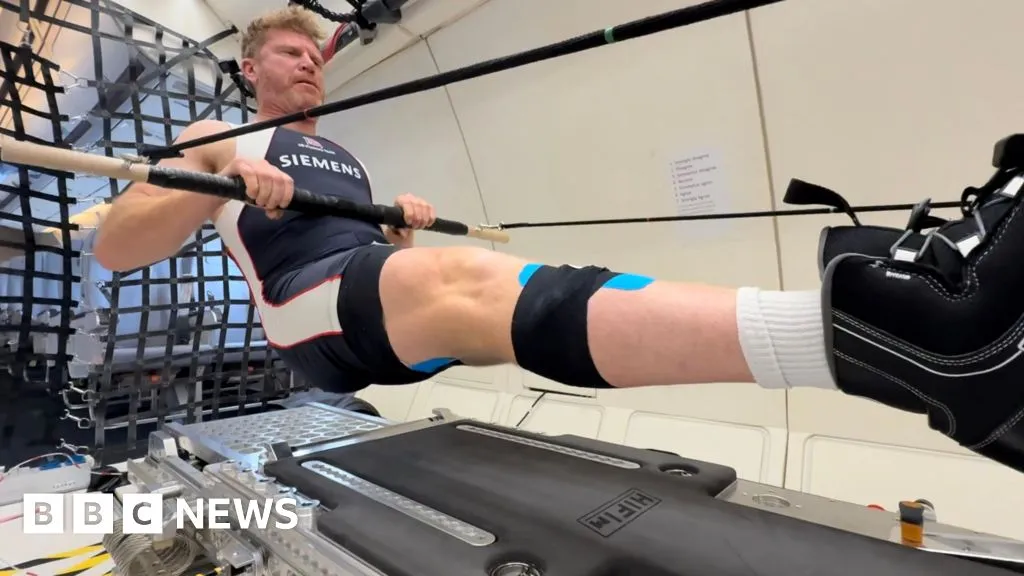
In a remarkable demonstration of possibility, Olympic rower Matthew Wells recently participated in a parabolic flight, soaring 8,500 meters (approximately 28,000 feet) above the Earth. For 22 seconds, he experienced weightlessness, devoid of any water beneath him, as he rowed against the backdrop of zero gravity. This unique endeavor is part of an international initiative aimed at developing innovative gym equipment that will keep astronauts physically fit during extended missions.
The apparatus Wells was testing is known as HIFIm (High-Frequency Impulse for Microgravity), a cutting-edge piece of equipment developed under the auspices of the European Space Agency (ESA) and involving contributions from NASA, the Canadian Space Agency, and the UK Space Agency. This collaboration underscores the urgent necessity for effective fitness solutions that can be deployed on upcoming moon bases and in future orbital space stations.  Mikhail Nilov on Pexels' alt='Astronaut Exercise Equipment testing'>
Innovative Solutions to an Ongoing Challenge
Astronauts are required to engage in a minimum of two hours of exercise daily aboard the International Space Station (ISS) to maintain muscle and bone density. Traditional exercise machines, however, demand significant daily commitment that may not always be feasible during demanding missions. The HIFIm prototype aims to provide a more efficient means of maintaining astronaut fitness by optimizing workout routines in microgravity.
“Isn’t it every kid’s dream to be an astronaut?” Wells commented. “To contribute to something that may one day float in space is simply out of this world.” His enthusiasm mirrors the sentiments of many involved in this innovative venture, all striving to advance human capabilities in space exploration.
A Global Cooperative Effort
Developed through a competitive framework among European consortia, HIFIm was initially designed for the planned Gateway Space Station, an orbital facility intended for lunar exploration, according to Dr. Meganne Christian, a reserve astronaut for ESA and Senior Exploration Manager at the UK Space Agency. Despite setbacks related to the Gateway project, Christian expressed optimism about the vast potential of these fitness technologies amid a rejuvenated interest in sustaining long-term human presence on the Moon through NASA’s Artemis missions.
HIFIm is not alone in the race; teams worldwide are vying to create exercise solutions tailored to the challenges of space. Notably, the European Enhanced Exploration Exercise Device (E4D), crafted by the Danish Aerospace Company (DAC), is currently undergoing astronaut testing and offers versatile modes, including resistive training and cycling capabilities enhanced with motion capture technology.
Preserving Health in Microgravity
The recent Artemis II mission showcased a specially engineered exercise device called the flywheel, further emphasizing the critical role of innovative fitness solutions in the health and performance of astronauts. As Dr. Dan Cleather, a professor of strength and conditioning at St Mary’s University who is part of the British HIFIm development team, articulated: “In space, we don’t experience any forces, leading to muscle and bone deterioration without adequate exercise.”
This necessity underscores the importance of developing technology capable of monitoring effectiveness and ensuring astronauts can maintain coordination and cardiovascular fitness while executing essential tasks in confined and challenging environments.
The Road Ahead
As this growing field of research continues to evolve, the emphasis on astronaut health and performance in extraterrestrial conditions remains paramount. Just as human ingenuity has propelled us into the cosmos and through previous challenges, the race to develop effective, time-efficient exercise solutions may very well determine the success of humanity’s next great leap into the stars.
Source: BBC Science